

Launching the IMWBN
Marine wood-boring organisms – piddocks, shipworms, xylophagaids, chelurids, gribbles, and sphaeromatids – sit at the intersection of aquaculture, biotechnology, cultural heritage, ecology, evolution and paleontology. Yet despite their global distribution and profound historical, ecological, and economic significance, the field remains niche, fragmented, and under-recognised. The establishment of the International Marine Wood-Borer Network (IMWBN) is both timely and necessary to consolidate expertise, accelerate discovery, and elevate these organisms into the scientific and public consciousness where they belong.
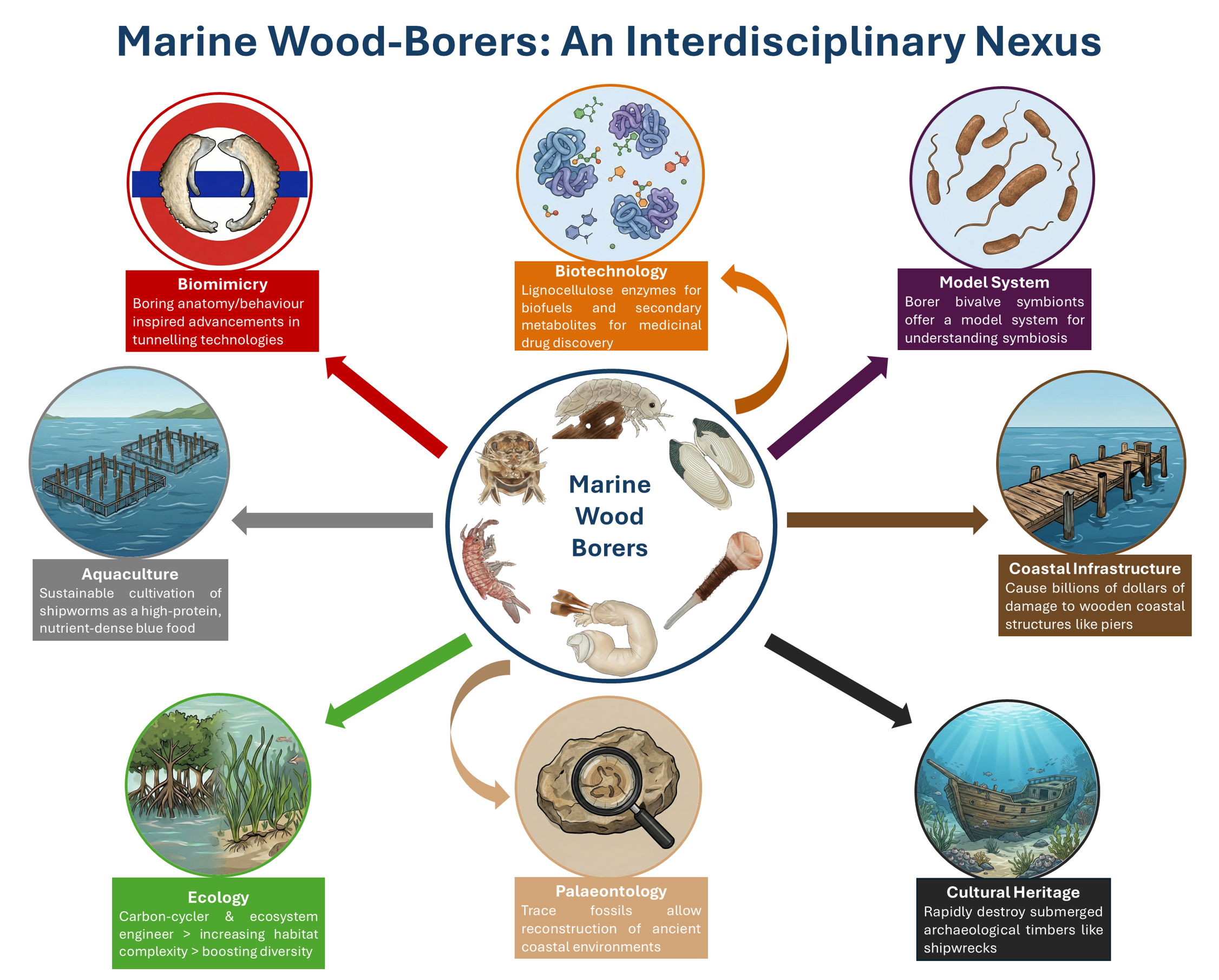
Why a Network Is Needed – Now
1. To Grow & Connect a Dispersed Scientific Community
The community working on wood-borers is talented but small, decentralised, and often siloed. A network will:
bring together researchers from across disciplines and continents
create new collaborations and opportunities
enable cross-training of students and early-career researchers
increase the overall volume, quality, and impact of research
build community with belonging and shared purpose.
This is especially important in a field where researchers are dispersed across several disciplines and regions.
2. To Popularise & Mainstream the Taxa
Public understanding of marine borers is exceptionally poor. Most people have never heard of a shipworm; those who have likely know them only as pests. This perception is centuries old, fossilised, and deeply misleading.
To illustrate:
Everyone knows what a bee is. Even a child understands the basics: bees pollinate plants, underpin food systems, and produce honey. They have cultural value, ecological value, and economic value.
There is no equivalent cultural narrative for marine wood-borers, despite the fact that they:
process vast quantities of terrestrial carbon flowing into coastal seas
prevent ports, estuaries, and harbours from becoming choked with floating wood
maintain energy flow into deep-sea ecosystems via wood falls
create habitat and micro-ecosystems through their burrows
have microbiomes that produce novel antibiotics, enzymes, and bioactive compounds
offer extraordinary potential as sustainable blue-foods
are evolutionary superlatives in symbiosis, wood-digestion, and extreme niche specialisation.
This mismatch – between importance and recognition – is precisely why a network is required.
3. To Rehabilitate the Image of These Organisms
Marine wood-boring organisms, most notably shipworms and gribble, have been framed predominantly as destroyers, including wooden coastal infrastructure, sailing vessels, and underwater cultural heritage. This “pest” narrative ignores their ecological role as keystone ecosystem engineers, their unmatched ability to recycle lignocellulosic carbon, and their potential contributions to sustainable food systems and biotechnology.
A coordinated narrative shift – through outreach and global engagement can reposition them as:
critical ecological recyclers and actors in planetary carbon cycling
ecosystem engineers that boost biodiversity through increasing habitat complexity
providers of enzymes, metabolites, and new antibiotics
sources of sustainable, high-quality protein
model systems for symbiosis research.
4. To Improve Engagement With Funders, Editors, & Reviewers
Other research communities – e.g., termites or coral reef symbiosis – enjoy well-established recognition. Termite researchers never have to justify the importance of termites as decomposers or ecosystem engineers, just as coral researchers do not need to explain the basic role of zooxanthellae in reef metabolism. In contrast, marine borer researchers routinely expend valuable space and time explaining what their system is and why it matters.
A network that amplifies visibility and communicates the system’s value clearly and repeatedly ensures that:
editors recognise the field immediately
reviewers understand its relevance and urgency
funders see high-level alignment with global priorities, such as blue food, anti-microbial resistance (AMR), climate, biodiversity, cultural heritage.
5. To Highlight Timely Global Challenges That Wood-Borers Help Address
Antibiotic Resistance & Drug Discovery
Shipworm symbionts are a largely untapped reservoir of novel, potent antibiotics, making them a frontier in natural product discovery – urgently needed in an era of rising antimicrobial resistance.
Blue Foods
One-third of global emissions come from agriculture. Even a complete stop in fossil fuel emissions cannot hold the world below 1.5°C unless food systems fundamentally change.
Shipworms present a transformational opportunity:
a zero-land, zero-feed, sustainable blue food
rich in protein and key essential micronutrients
already considered a delicacy with a range of reported health benefits
potentially the world’s fastest growing bivalves, with growth up to 3× faster than blue mussels and some species reaching final sizes >1.5m in length
major potential for global aquaculture and adoption.
Coastal Change & Biodiversity Loss
Deforestation and coastal urbanisation have drastically reduced the flux of wood into the oceans, with likely (albeit poorly studied) consequences for marine wood-borer communities and the biodiversity they support. This mirrors, in many ways, the collapse of whale falls during the peak of historic whaling. Understanding this decline requires coordinated global monitoring – something only a network can deliver.
Climate-driven range shifts and cultural heritage risk
Warming seas are enabling wood-borers to expand their range, with major implications:
the Baltic Sea, for example, long protected by cold temperatures and low salinity, is now vulnerable to increased shipworm activity
underwater cultural heritage (shipwrecks, submerged settlements, wooden artefacts) faces renewed threat
coastal infrastructure previously considered safe may need reassessment.
These threats require international cooperation, shared methodologies, and harmonised data.
Benefits to the Community
The network will deliver:
Greater visibility for all researchers’ work
More citations, more collaborations, more grants
A structured pipeline for early-career development
Shared tools and protocols
A home for workshops, webinars, and training
A platform to tell the story of these animals to the scientific community, policy makers, public, and industry
A unified, global voice arguing for the ecological, economic, and biotechnological value of wood-borers
A higher baseline of understanding so that every paper need not start by defending its own importance.
Why Now?
Because the convergence of:
the climate crisis
the global search for new antibiotics
the need for sustainable proteins
the acceleration of coastal development
the renaissance in marine microbiology
the expansion of environmental DNA and imaging tools
the urgency of protecting underwater cultural heritage
…makes this the most important moment in history to understand and champion marine borers.
These organisms have shaped human history for millennia; they may shape solutions for the next millennium. A coordinated, international network is how we ensure the science grows at the pace the planet now requires.
Mission / Vision / Values
Mission
To unite and empower the global community of marine wood-borer researchers, advancing scientific understanding, collaboration, and communication to elevate the ecological, cultural, and biotechnological significance of these extraordinary organisms.
Vision
A world where marine wood-borers are recognised as essential ecosystem engineers, vital contributors to sustainable blue-food systems and biotechnology, and key players in global carbon cycling – supported by a thriving, collaborative, and internationally connected research community.
Values
Collaboration: We work across borders, disciplines, and generations to build a genuinely global network.
Scientific Excellence: We support rigorous, high-impact research that deepens knowledge and drives innovation.
Openness: We share data, tools, and expertise to accelerate discovery for the entire community.
Inclusivity: We elevate early-career researchers, under-represented regions, and diverse perspectives.
Stewardship: We recognise the ecological and cultural importance of wood-borers and advocate for their responsible study, conservation, and sustainable use.
Communication: We promote accurate, compelling narratives that rebuild the reputation of marine borers as ecosystem engineers and contributors to planetary health.
Innovation: We champion novel applications – from drug discovery to blue foods – that unlock new societal benefits.
