

About the IMWBN
The International Marine Wood-Borer Network (IMWBN) is a global community of researchers, practitioners and enthusiasts dedicated to the organisms that live in, eat and transform wood in the sea.
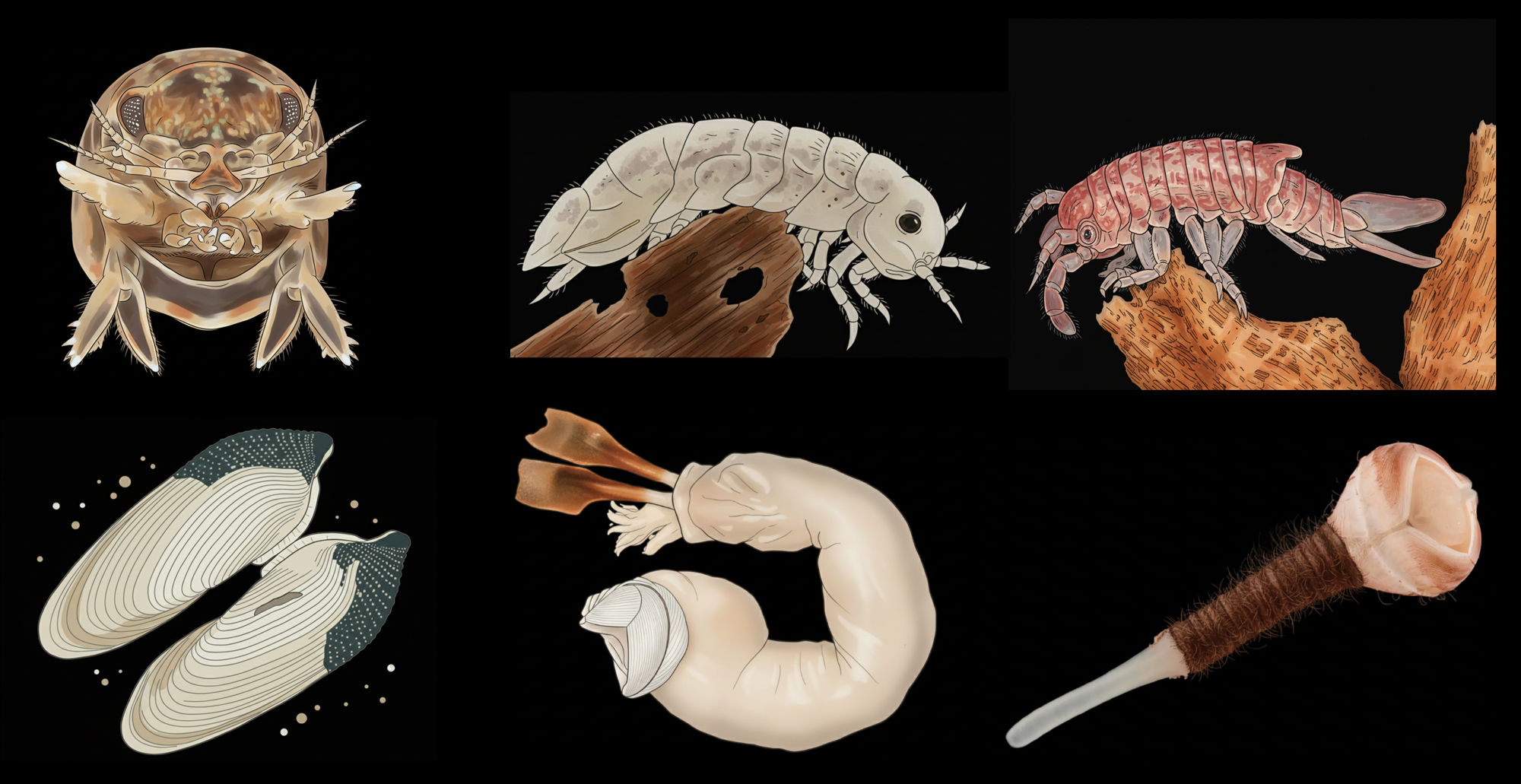
Marine wood-borers include shipworms (Teredinidae), piddocks, xylophagaids, gribbles (Limnoria), chelurids, sphaeromatids and their allies. These animals tunnel through submerged wood – from mangrove roots and driftwood to harbour pilings and historic shipwrecks – using specialised shells, mandibles and microbiomes to break down lignocellulose that most organisms cannot digest.
For centuries, wood-borers have quietly (and sometimes dramatically) shaped human history and marine ecosystems. They have:
recycled vast quantities of terrestrial carbon entering coastal seas
prevented ports, estuaries and mangroves from becoming clogged with drifting timber
created complex burrow networks that act as habitat and refuges, boosting biodiversity
damaged fleets, piers and underwater cultural heritage, with economic impacts running into billions of dollars
Today, they sit at the heart of several frontier research areas. Shipworm symbionts are a rich source of novel enzymes, antibiotics and bioactive compounds, and form a powerful model system for studying symbiosis. Naked clams – farmed shipworms – are emerging as ultra-fast-growing blue-foods capable of turning low-value wood waste into high-value protein. Fossil borings extend their influence into deep time, helping reconstruct ancient climates, shorelines and ecosystems over millions of years.
Despite this breadth and importance, no formal global network has ever existed – and awareness of their ecological and biotechnological importance remains limited. The IMWBN was created to change that.
We unite people working on marine wood-borers across biology, ecology, palaeontology, microbiology, aquaculture, conservation, engineering, heritage science and biotechnology. Our goals are to:
connect a global community and spark new collaborations
raise the visibility and scientific profile of marine wood-borers
synthesise and share research through an annual field-wide review
celebrate excellence through IMWBN Awards
support early-career researchers and under-represented regions
build shared tools, narratives and resources that strengthen communication across the field
In short, the IMWBN exists to give marine wood-borers – and the people who study them – a proper home: a place where this field is visible, impactful and high-profile, and where these remarkable “boring” organisms can receive the attention they genuinely merit.